
Describe the app. We build the agents, tools, workflows — and ship it.
App Foundry turns a plain-language prompt (plus the agent and workflow definitions you already own) into a durable, streamed build: PRD → blueprint → scaffold → generate → verify → deploy. The output isn’t a chatflow — it’s a self-sustaining app with its own database, container, tests, and run ledger.
- PRD-first + HITL
- Self-verifying (pytest + Playwright)
- Self-hosted & multi-tenant
- Run ledger
Build a competitor-intel app: scrape rivals weekly, summarize pricing changes, email a digest, and expose an API.
Integrations & connectors, provisioned as MCP clients
From a prompt to a running app you can watch being built.
An agent that researches competitors: scraper MCP, a summarizer tool, and a reporting sub-agent that emails a weekly digest.
1 · Build intent — prompt, attached definitions, build mode & surfaces
Build a competitor-intel app: scrape rivals weekly, summarize pricing changes, email a digest, and expose an API.
2 · Orchestrator — live stage stream, gates, preview / code / manage
How Vastvic’s deep-agent harness actually works.
Every build is driven by a harness — a durable ReAct loop with planning, sub-agents, memory, MCP tools, and human-in-the-loop interrupts. It’s the same substrate whether you’re forging one tool or a whole app.
A prompt goes in. Agents, workflows, and a running app come out.
The forge is the same substrate for every build — whether you’re shipping one agent or a whole app. Attach what you already own, or let the blueprint decide the rest.
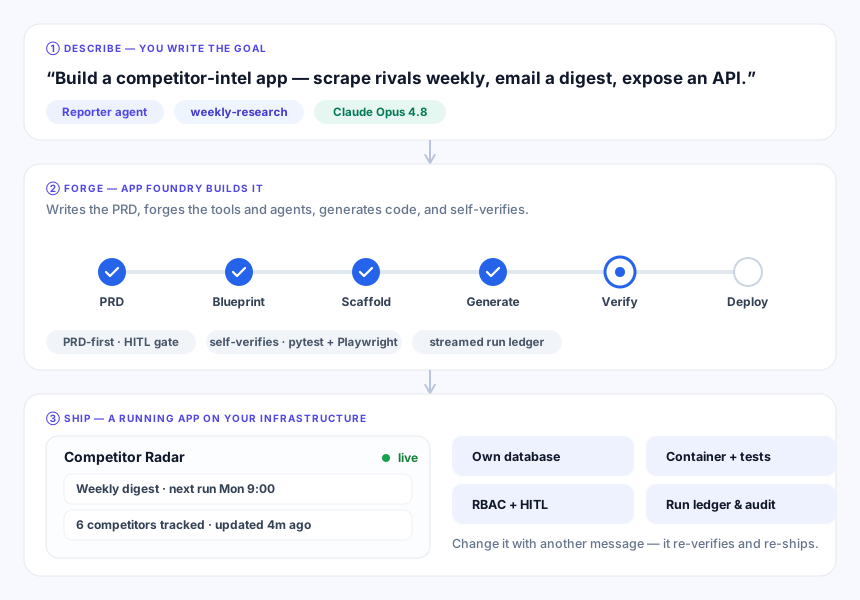
One prompt generates agents, tools, workflows — and the app around them.
Attach the definitions you own or let the blueprint decide. The harness provisions MCP servers, registers tools, spawns sub-agents, and wires a workflow schedule — then generates the code that runs them.
- Reasoning & workflow agents with personas, skills and harness bindings
- MCP servers forged and mounted as first-class, governed tools
- Workflows compiled into the build and executed by the flow engine
- HITL interrupts on risky actions (execute / write / deploy)
- Durable memory + a unified run ledger across every step
Every integration is a governed MCP tool.
Pick a connector and App Foundry provisions a real, MCP-callable connection through the unified gateway. Credentials are entered behind an HITL boundary — the agent never sees a raw secret until you approve it.
Payments
Stripe, Razorpay, PayPal, Paystack — billing as a tool.
Auth & identity
Google sign-in, Microsoft Intune device gates.
Messaging
SendGrid, Twilio for email, SMS & verification.
Models
Anthropic, OpenAI, Gemini via unified model routing.
Autonomous, but never unaccountable.
HITL gates
Per build mode: gate the blueprint, deploy, or every stage. Nothing risky runs without approval.
RBAC & isolation
Tenant / space isolation and role-based access on every action, enforced at the gateway.
Unified run ledger
Every event, cost and token is traced — a complete, replayable record of the build.
Self-hosted
Runs on your infrastructure, multi-tenant by default. Your data never leaves.
Build your first app from a prompt.
Bring your agents and workflows — or start from a blank prompt. App Foundry forges the rest and ships a governed, running app on your infrastructure.